
Bloomberg’s Last Stand
The great unbundling and why MCP will redistribute value

The AI hype train has left the station. Everyone is in a PR frenzy, but no one can tell you where they are headed. Those onboard are shipping MCP connectors like they’re handing out candy. They are announcing platform partnerships with new AI-native players at breathtaking speed without breathtaking new revenue. All while the passenger manifest has a notable exception, that no one is questioning.
If you’ve been following these announcements, you’d be struck by some cognitive dissonance. How can MCP be a competitive differentiator, a demonstration of AI readiness, and a way to simultaneously grow the addressable market for all passengers? A competitive differentiator implies scarcity, and scarcity collapses the moment every competitor ships the same connector in the same year. TAM expansion implies entering territory you didn’t previously control; it doesn’t explain why you would plug your data assets into a new interface you don’t. AI-readiness without a commercial model is responsive PR without pricing power. And that’s not all that is missing.
The adoption frenzy comes with little commentary on what is being adopted. What no vendor explains is why the protocol is necessary or what protocols in general are meant to do. They avoid talking about its effects on data distribution, bundling, and competition, and certainly avoid any mention of how it changes their position and role in the value chain. None have articulated how their AI-related revenue will be quantified, or what new customers or usecases the new connector is aiming to serve. No one dares talk about how pricing power deteriorates when data reaches a customer through a third-party AI platform. Doing any of those would mean revealing the second-order effects of the protocol on their revenue and margins. Instead, they misdirect attention elsewhere.
What vendors have disclosed regarding the new opportunity shares a pattern. Three tiers of vanilla vagueness. First, a proxy metric. ‘We are seeing a strong adoption signal. Inbound interest is growing, and we are engaged in multiple client conversations.’ Then an assertion. ‘AI creates more demand than it displaces. Agentic use is going to skyrocket.’ And then a deferral. ‘The commercial framework for monetising this opportunity will become clearer in the coming period.’
Investors are still waiting for that period, while pondering the notable missing passenger. Bloomberg has not exposed an MCP server. No endpoint into Claude for Financial Services, ChatGPT, Gemini Enterprise, or Copilot Studio. No analyst note or earnings call to explain the absence1. Why would the industry leader, best poised to leverage any new protocol, refrain from following their peers?
For decades, the financial data industry’s pricing power was built on both the data, and the interface that organised access to it. A walled garden that kept switching costs high and prevented data from being interoperable. By channelling their data through a coordination layer they don’t own, every vendor that shipped an external MCP connector has made two implicit concessions. First, they made their data queryable, comparable, and routable against every competitor who has also connected. Second, the interface through which their data is accessed will no longer remain theirs.
Bloomberg chose not to concede either. Instead, they built an agentic layer inside the Terminal itself, keeping every interaction inside the interface they spent decades making indispensable. A company doesn’t make that trade unless its own read of opportunity draws from a different mental model. One that is informed by a technical precedent that played out during the first terminal wars. When an unassuming new protocol disrupted the economics of an entirely different industry (and unexpectedly gave Bloomberg a secret weapon to beat Reuters in the 90s). Today, we explore what that precedent teaches us and uncover whether history is poised to repeat itself.
History offers a clear lesson about what happens when the edge becomes intelligent, and the pipes and the content they carry become dumb. Most data vendors will learn that lesson the hard way.
Author’s Notes
This post explains MCP and the mechanics of the disintermediation in the least technical way possible, using analogies that are familiar to us. Read along if you’d like to learn everything there is to know about MCP, AI, and the orchestration opportunity; why Claude for Financial Services was even possible; and how lazy vendors are suddenly able to ship so many connectors to every AI playground. We’ll touch on why consumption-based pricing is detrimental, why MCPs’ second-order effects create a new wedge, and why the industry’s stifling licensing architecture must finally break. We’ll also look towards the new: what can be built, what’s necessary to win, and how to do it without incumbent blockers.
The post is structured into four acts. Act I establishes the preceding protocol’s disruptive effects. Act II identifies the parallel in the financial data stack. Act III demonstrates how a similar disruption will unravel, while Act IV introduces Distribution 2.0 and the opportunities it brings.
It continues the thesis we’ve been building on the current Distribution model. We’ve already discovered the industry’s business model (conceptually in The Smiling Curve and commercially in 10,000x Returns), why the terminal is in decline (in Post-Terminalism), and why the long-held moats are deteriorating (in Distribution Fallacy). This post reveals the attack vector and the mechanism through which data aggregators stand to be disrupted.
While some might disagree on the nuances (the post cannot account for every vendor or dataset), the broad strokes thesis of the essay hopes to provide the clearest articulation of how the industry is going to evolve. Those more technically inclined may disagree on MCP’s feasibility and longevity for financial data. The author, in fact, agrees on this point and thinks MCP will iterate toward a more performant protocol. But that argument is outside the scope of this essay, whose purpose is limited to understanding the irreversible industry implications of adopting a disintermediating protocol, however imperfect.
We’ll start by unpacking what hidden disruption looked like the last time a new protocol was introduced and why incumbents never saw what was coming. Remember, analogies aren’t meant to be precise; they are meant to simplify complexity while giving you the most approximate frame of reference to make decisions. Treat Act 1 as such.
Act I — The Precedent
June 2011: Comcast executives present their Netflix analysis to the board. The conclusion is reassurance. The board’s read: Netflix users are movie/TV enthusiasts who watch more cable, not less: “cord-supplementers, not cord-cutters.” Only 3% of subscribers had cancelled cable. Live sports remained exclusive to the bundle, the anchor asset was intact. Even industry analysts viewing the same data reached the same conclusion. Over-the-top services were not pay-TV slayers. They were right about the data; they were wrong about what the data was measuring.
Within a decade, Comcast lost a majority of the business that had taken generations to build: the cable-TV subscriber relationship. What Netflix built sat one layer above the pipe Comcast owned, and it wasn’t “video” in the sense Comcast competed on. It was a video service that the viewer fully controlled from an intelligent endpoint. An app to access any title, on demand, at any time, on any device. Comcast had spent decades optimising channels, schedules, and bundles; Netflix made all three irrelevant at once.
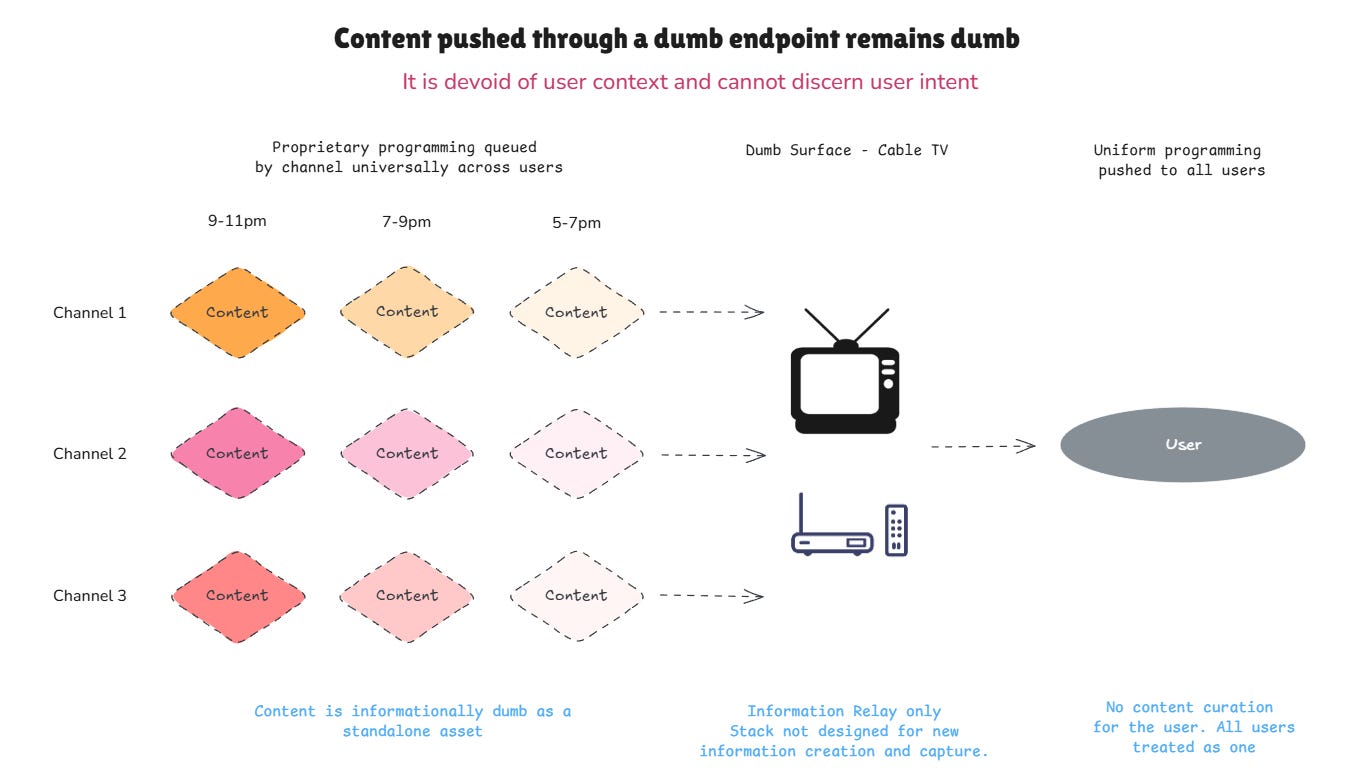
Ironically, Comcast’s broadband build-out was the road Netflix arrived on. The more Comcast’s invested in their broadband, the better Netflix worked without having to pay Comcast a dime2. But Netflix was just the capstone of the telco industry’s disintermediation process set in motion roughly two decades earlier.
---
In the mid-1990s, telcos and cable companies began wiring homes for the internet, pouring billions into the physical infrastructure that would carry it. The assumption underneath that investment: whoever owns the wire controls the terms on which value moves across it. This is how every prior infrastructure business had worked — own the oil pipeline, the road, the rail line, and you have leverage (as a tollbooth) over what travels on it.
By the time telcos were laying that cable, the form the tollbooth could take was decided without their permission and outside their control. A new information transport protocol3 had arrived: open-sourced, permissionless, decentralised, interoperable, scalable, and fault-tolerant. Its obvious benefits meant anyone could build on and connect through it without negotiation. And every new participant made it more valuable for everyone already connected, a flywheel that out-competed every proprietary, gatekept alternative. By the time the World Wide Web arrived, TCP/IP wasn’t a protocol that telcos could choose to adopt or reject. It was simply what “the internet” meant.
Buried inside its design was a property whose second-order effects were unappreciated by those spending large sums to build the internet’s connectivity layer. The protocol would be blind and indifferent to what could be carried over it. Which meant it would be priced by unit volume rather than the value that passed through it. TCP/IP doesn’t ask what an information packet contains before moving it; it just moves every packet uniformly, discretely and independently. That single property — blind to content — decided which part of the value chain accrued enduring profits, even to this day.
A letter costs the same to mail whether it contains a birthday card or a winning lottery ticket. Postage of envelopes is priced by the size of the envelope, never by what’s inside it. TCP/IP was blind in the same way: it moved a packet of video, or a phone call, or a stock order under identical terms. For physical mail, this blindness has a limit. You cannot post a piano. The range of things subjected to value-blind pricing was itself capped by the size of the envelope. Pianos had to be treated as special cargo. Priced by the risk and effort involved in moving it, allowing the postal system to charge commensurate and differential fees.
TCP/IP being indifferent, removed such limits. Risk and effort did not change irrespective of the size of the digital cargo. And unlike a piano, none of the cargo needed to survive the trip intact. The protocol was unique in that it could break the digital cargo into identical, standard-sized packets, ship each independently across different routes, and reassemble them perfectly at the other end, at no additional cost to either party. It was as if the postal service didn’t just ship your piano regardless of size; it took the piano apart, shipped it in identical boxes alongside everyone else’s parcels, and put it back together on the other end, fully tuned. All while charging you the same as it would to ship a similar number of cotton boxes.
Price was fixed by the size of the smallest unit of carriage, which had to be economically viable for the lightest possible load. That is the position TCP/IP put the telco industry in, permanently, and before they’d even finished building the infrastructure.
The dot-com boom followed, as connecting to and distributing through the internet became essentially free. It would take a bust and another decade before signs of the first intelligent layer above those pipes emerged.
---
In January 2007, Steve Jobs announced the iconic first iPhone. In June 2007, AT&T brought it to the public under an exclusive five-year partnership, reading the deal as a coup. Premium smartphone subscribers are high-value, the exclusivity locks out its rivals, and AT&T’s existing revenue streams (voice & messaging) would grow with data, with AT&T taking a cut of any value-added services (ringtones, games, wallpapers, web portals) bought through its carrier deck, as had been the industry norm.
A year later, Apple nuked AT&T’s growth projections. The App Store launched in July 2008, distributing applications directly from Apple to users. Services could reach their target market outside the carrier’s gating workflow, with Apple capturing the revenue share instead of AT&T. Five hundred apps on day one became hundreds of thousands within two years, with many replacing the carrier’s value-added services digitally.
The value chain inverted through a single handshake (the iPhone partnership), and the inversion was invisible at signing; it became undeniable over the three years that followed.
For the consumer, the difference wasn’t subtle. AT&T’s carrier deck was a curated handful of apps, selected based on what generated revenue share for AT&T, billed awkwardly on the phone bill. The App Store was instant, searchable, judged by users rather than by carriers, and updated continuously. It followed the user, not the network: switch phones, switch carriers, switch countries, and the apps, purchases, and identity came with you. Apple was offering something AT&T’s stack was never designed to do at all.
AT&T’s error? They correctly knew that control translated to pricing power, but misidentified which layer the control point now resided in. Up to that point in history, carrier control was flexed through owning the network, papering the contract, issuing the bills and using their distribution reach to demand device gatekeeping - which devices, and pre-loaded apps and features shipped to their customers.
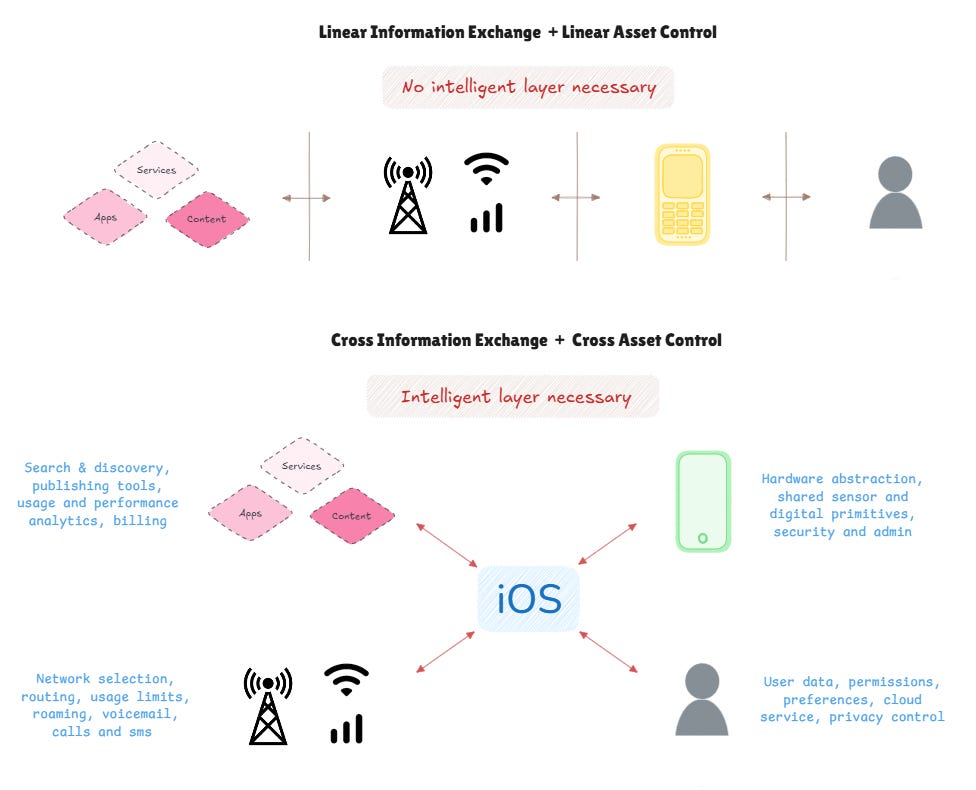
Apple built a new layer above everything AT&T controlled. A coordination layer that orchestrated the relationship among the device hardware, the software running on it, and the user’s identity as they interacted with and transacted in the digital world. AT&T kept everything it had always had but lost control to a new type of asset the user now valued: the intelligent surface powered by the iOS, with access to thousands of services and products via the App Store, and seamlessly managed through the Apple ID that tied purchases, content, and settings to a person across every device they owned.
Apple iOS was built deliberately outside AT&T’s stack, designed from the start to deny AT&T any control or revenue on the ecosystem forming above it. The foresight gap was total: only Apple had visibility into what that ecosystem would become, and no amount of due diligence or contractual clauses could have allowed AT&T to see what was coming. The moment that intelligent layer formed over AT&T’s pipes, the death warrant was signed, not just for AT&T but for the industry’s entire profit pool and margin profile.
And it wasn’t that AT&T could have said no. The terms AT&T was willing to accept (exclusivity, revenue share, ceding the user experience) were dictated by what AT&T’s own competitive position could bear. Wireless service was already being commoditised. If AT&T didn’t take this deal on Apple’s terms, a competitor would eventually, and AT&T would be the carrier without the iPhone.
As the dumb phone gave way to the smart one, the intelligent OS began to accrue all the new value, forcing the dominant asset owners till that point to turn their infrastructure into a dumb pipe. Scarcity at the OS layer meant that the digital plane was the true point of control, not the physical world of devices, towers & cables.
---
The inversion of power (and value) from carrier-controlled services to smartphone-accessed, OS-orchestrated app stores was dramatic. A flood of competitors followed because the carrier dam that was gating access was broken.
The App Store exploded because it trivialised the distribution layer (discovery, billing, identity, continuous updates) that any new application needed to launch and scale globally. The store was orchestrated by an OS that provided a unified platform to abstract away hardware complexity, allowing developers to focus solely on the app. All a developer needed was an idea and an internet connection (thanks to TCP/IP). The tech industry’s disruptive best came rushing forward.
WhatsApp launched and began destroying SMS revenue, the carrier’s highest-margin product. Skype and Vonage did the same to voice ARPU, simultaneously. They served the disruption over the carrier’s own wire, with the user paying for postage. Netflix and Spotify ate away at bundled video and music revenues. New categories of value appeared. Google’s mobile advertising business became the dominant advertising model in history by capturing granular information from the very same devices and users the carriers contractually managed. Data that the carriers’ stack could never access, not without their own software layer.
The flood of apps ate away at revenue streams the carriers considered untouchable (and sacred). One that Jobs never let on when he introduced the early test iPhones to AT&T execs. Back then, there was no App Store and no iMessage. Nothing to hint that a whole developer universe was waiting to create voice and SMS alternatives for free. But Apple knew exactly what their roadmap was worth. The OS, the App Store, and the identity layer it would quietly assemble made Apple the one gate any new application or service would have to pass through to reach a user, on terms Apple set and could change unilaterally.
Google’s answer was the mirror image: give the operating system away, so no single company could close that gate the way Apple just had. Between a closed gate charging rent and an open alternative, the carriers had no third option to offer. They could only watch as their network assets, which had generated billions in revenue, were demoted to commoditised inputs. The loss in voice and messaging revenue was not relieved by data. The smartphone-led boom didn’t translate to pricing power or higher margins as carriers couldn’t anticipate the competitive dynamics that would follow.
Carriers were forced to compete on fungible data plans, driving per-gigabyte pricing down and making unlimited data the norm. Investments in each successive network generation (3G to 4G to 5G) multiplied available network capacity, mechanically pushing the cost of carrying a given unit of data down further still. OEMs and mobile operating systems competed to make every byte do more, through better compression, codecs, and caching, so the same activity consumed less data over time. None of these forces was carrier-controlled, and all of them pointed in the same direction: driving down the per-unit cost of data and capping carrier revenues.
The boom in data usage caught the carrier flatfooted. Their networks were overloaded, leaving them no option but to increase capex to meet service SLAs and maintain customer satisfaction. Data demand outstripped network supply, and for years, whatever thin profits they eked out, had to be ploughed right back into capacity upgrades. The carriers ended the decade carrying more traffic than ever, while capturing a smaller share of the value that their infrastructure enabled than at any point in their history. The pain wasn’t going to stop.
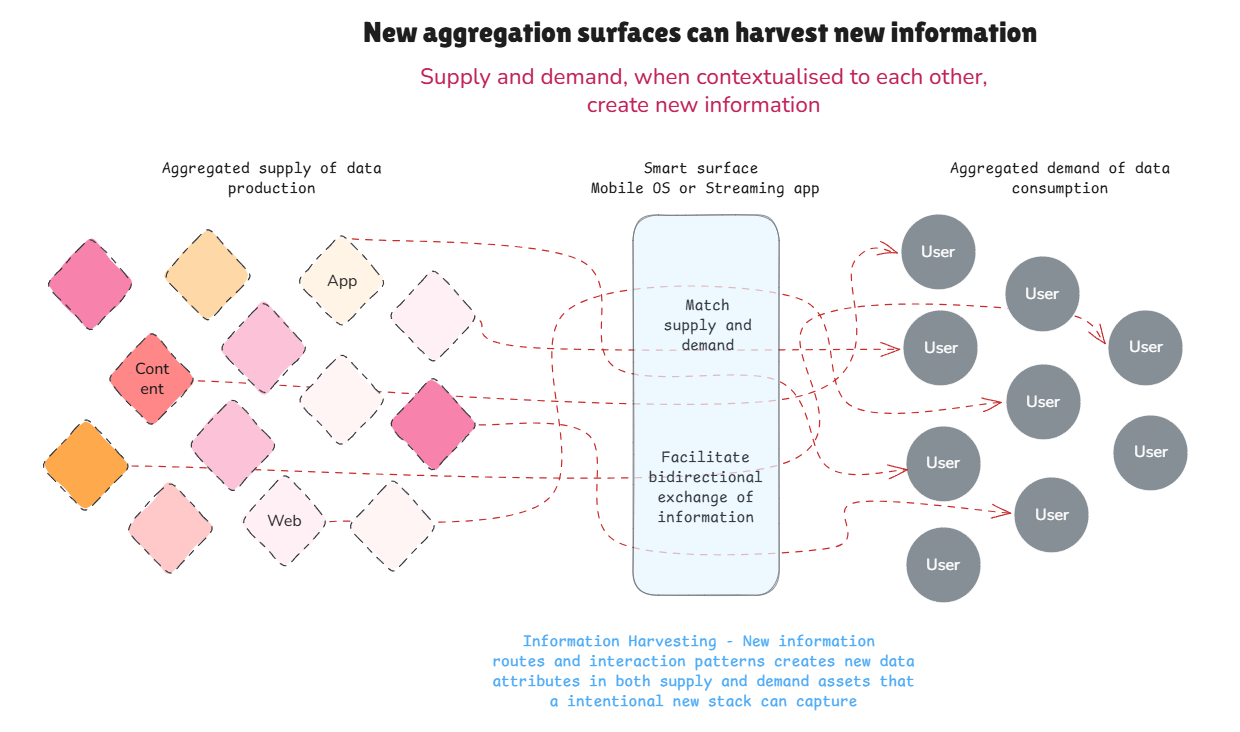
While Apple made the OS the intelligent point of control, Netflix made the app more intelligent than the set-top box and the satellites carrying the programming to it.
---
Cable-TV incumbents and their carrier parents couldn’t see the next intelligent endpoint coming either. Because it happened outside the carrier stack on a new surface (the app) that orchestrated the exchange of information between the user and their programming. One that re-wrote supply and demand dynamics faster than the industry could respond.
On the supply side, Netflix’s shift to a direct-to-user digital platform meant they could do things no cable-TV network could. It could monitor user consumption patterns in granular detail to inform its per-user recommendation engine, while also informing the production of new content that would resonate with users. The Netflix platform produced real-time intelligence that helped orient its catalogue and production, while the old stack ran on delayed, third-party estimates of show ratings. It was an unfair fight before it even began.
On the demand side, the direct-to-user platform allowed new capabilities. The shift to streaming and on-demand created enormous new value to customers - what you want, when you want, wherever you want. It introduced an unplanned and unscripted consumption pattern - binge-watching. The old stack, yet again, could not respond. It had to be painfully reinvented over the coming decade to serve emergent user needs, giving Netflix enough time to pull ahead and become the industry’s dominant force. And the leading price-setter. Everyone who followed had to be a price-taker on the commercial model Netflix set.
Netflix’s model permanently disaggregated all existing carrier bundles. The triple-play bundle’s pricing power depended on one thing: none of its three components had a credible, independently-priced equivalent. A subscriber paying $80/month for broadband, cable TV, and phone had no way to ask “how much of this is the TV part?”. The price was opaque by construction, and that opacity was the point: it let Comcast price the bundle above what any part would fetch alone.
Netflix gave the cable-TV component a price tag: $8/month for standalone on-demand content. The moment that price existed, the comparison became unavoidable: if TV is worth $8, what’s the other $72 buying? The bundle’s opacity collapsed, forcing the remaining components to justify their value for $72. An impossible task as sim-only and broadband-only operators proliferated with asset-light models and pricing to match.
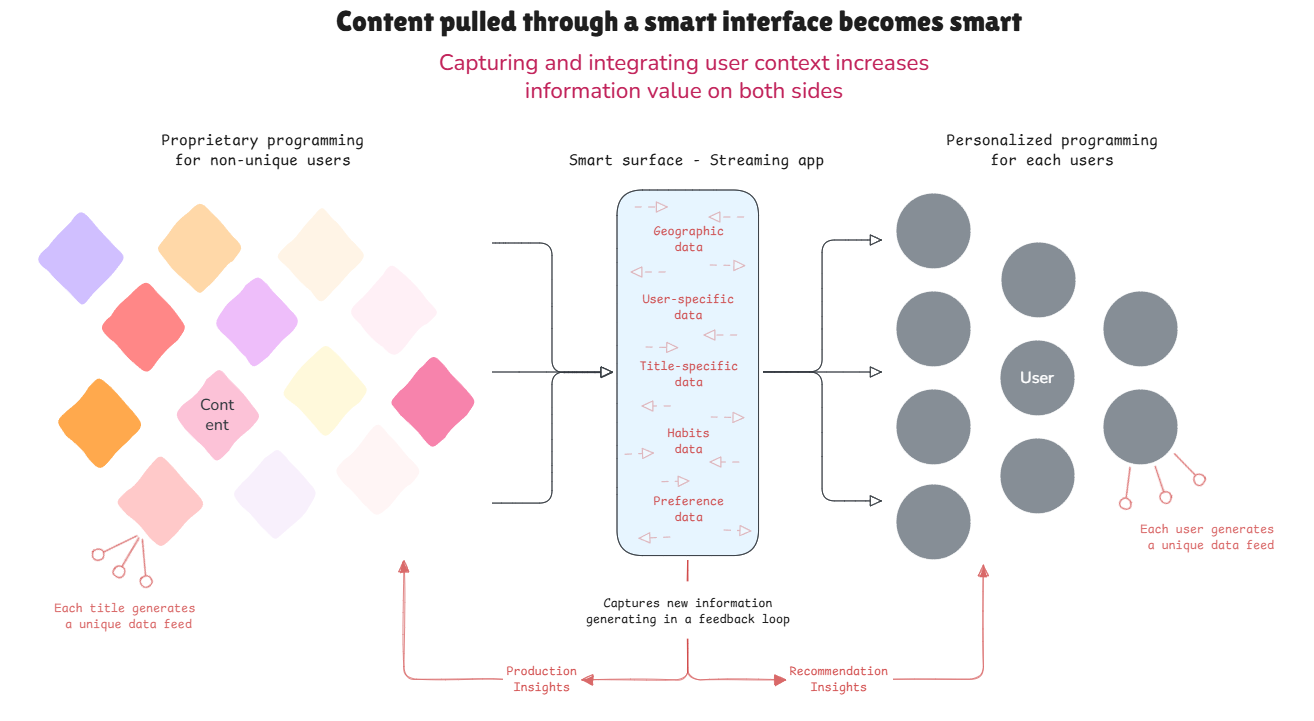
With a step change in value for users at a hard-to-resist price point, cord-cutting was an inevitable and arguably necessary outcome. What the carriers saw as a slow start was a misread of the rate of change to come. They could never be convinced that the arrest of the cord-cutters was impossible. That the new intelligence surface closest to the user had to accrue power, while the content4 and the rails that transmitted them became dumb. Despite the carriers having seen the disruption mechanism play out with the iPhone, they were unable to see it play out a second time with Netflix.
---
The carrier business model has taken a series of disruptive hits, but their assets have survived the onslaught. What didn’t survive was the position their assets conferred. Spectrum and cable stayed necessary. But once a new layer formed that governed how every asset, stakeholder and solution got combined and used, the old asset owners found their pricing power diminished. They faced positional displacement, technical disruption, and pricing disaggregation. No asset-heavy business model can survive all three simultaneously.
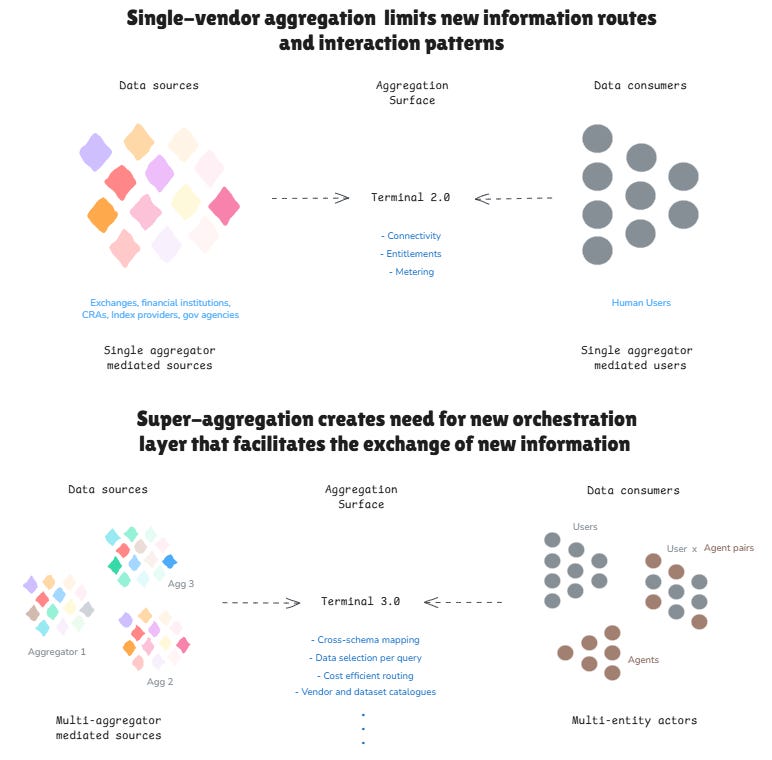
This is the pattern now forming in financial data. A new intelligent layer is taking shape above the existing data stack, one that customers will increasingly turn to first, and that will govern the exchange of data between users and the data owners. It will be the surface on which cross-vendor data is combined and used in new, previously unanticipated ways, sitting between upstream vendors and downstream workflows. Historically, this was the position data aggregation incumbents uniquely held. And as with the telcos, the incumbents are watching this layer take shape and, for now, welcoming it.
The parallel is striking as financial data, like spectrum assets, is scarce and licensed. Spectrum assets are physically scarce, requiring government allocation. Data assets are contractually scarce5, requiring legal enforcement. In both cases, a licence governs just the asset. It has never had jurisdiction over the position the asset can occupy in the value chain. That conflation is the first misread that has set off a silent cascade in the data industry.
MCP is arriving in financial data the way TCP/IP arrived in telecom three decades ago. Like TCP/IP trivialised transmission, MCP trivialises integration. Opening the door for an application layer more intelligent than the terminal to form in front of the user. One that can work across any data source, external or internal, and for the first time introduce entirely new business models that will alter how data is valued.
Act II establishes why the financial data industry, which exercises control over its ecosystem the same way the telecom industry does, is going to be subject to the same outcome.
Act II — The Mechanism
Both carriers and data incumbents exercise control of their position in the value chain through the same five axes. Leading their business model and unit economics to draw from a common commercial thread.
First, a controlled asset. The physical or digital substrate that gates the transmission of information. The towers, spectrum, and devices on one side against datasets, feeds and the terminal on the other. The assets defence wasn’t size, it was incomparability: there was no common layer through which one carrier’s spectrum or one vendor’s dataset could be accessed or checked through another’s. Neither the smartphone nor the terminal worked on a competitor’s network. How access gets policed turned ownership into leverage.
The gating architecture installed layered checkpoints that decided what could pass through to a customer or a third party. The carrier terms, device contracting, and approved apps are mirrored by licensing, entitlements, and third-party tool access. A staged progression that vetted which data could reach the consumption endpoint facing the user.
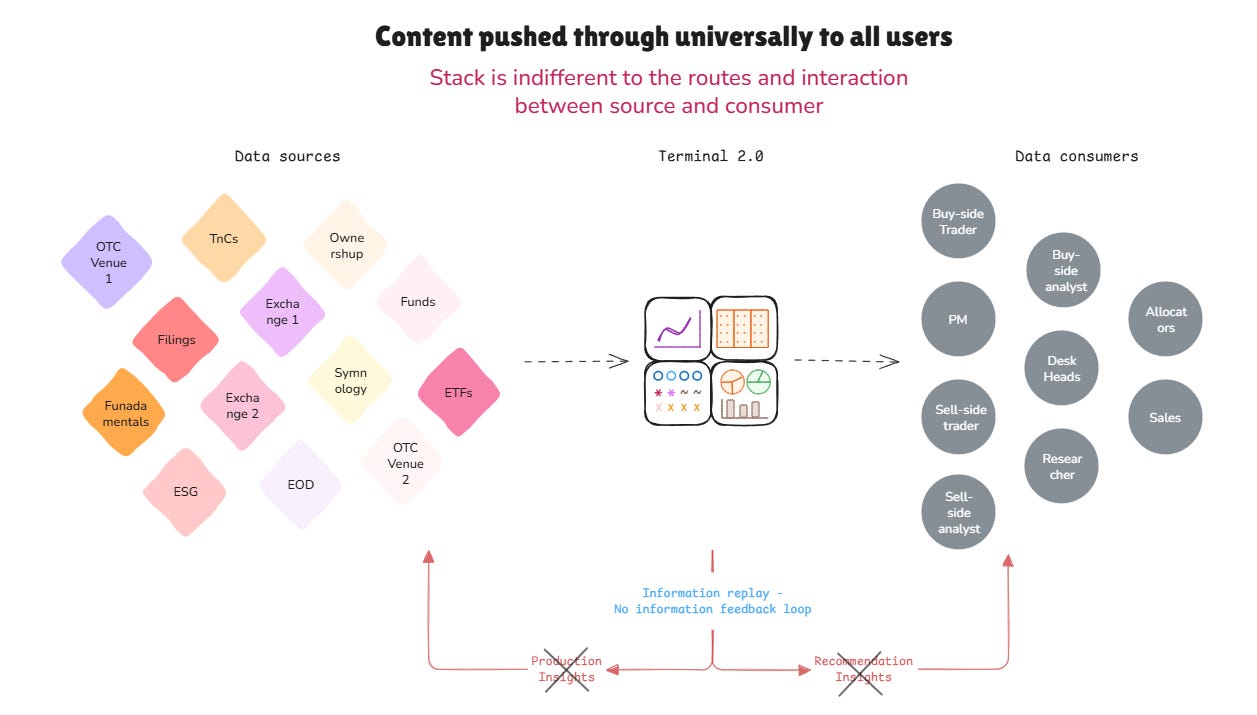
The interaction surface enabled the user to work with information to perform higher-order tasks, serving as a two-way control point for both the user and the vendor. Without having to manufacture devices, the carrier decided which OS updates shipped and when, often after inserting their own code to preserve their control. Financial data incumbents went a step further by exercising total control over the terminal and manufacturing the consumption device as well. Every supplier routed through the consumption device to reach the user. Run that control across enough suppliers and customers for long enough, and a shape emerges.
A many-to-many network topology. An aggregation hub with data production in and data consumption out, with the incumbent sitting in the middle of every data exchange. Abstracted to the topology level, carriers and data vendors look identical. Unsurprisingly, both monetise their position by raising identical toll booths.
The commercial model extracted rent per user per month, locked in through multi-year contracts with pre-scheduled price increases. The lock-in does double duty: it provides the incumbent with predictable revenue and the customer with budget certainty, irrespective of usage.
These axes of control are unilateral, allowing the incumbent stack to be the sole medium of information exchange across network participants. And hence the stack owner remains the sole intermediary of the ecosystem. Their toll booth collecting billions in rent on autopilot. But when a new protocol makes it permissionless and frictionless to reach anything and anyone, things start to unravel.
---
TCP/IP operated at the network substrate. Every node on the network was pre-baked with the universal transmission protocol, the way a standardised power socket is built into every room in every building. The carriers weren’t forced to adopt the protocol any more than they had a choice. The smart protocol trivialised transmission and reception of data, shifting that responsibility to the endpoints that wanted to connect, rather than burdening the network. With the network simply having to provide carriage, value containment felt assured. Telcos, after all, owned the pipe, the spectrum, and the metering. All carriage through the network would still have to settle, eventually, on the carrier’s terms.
But shifting that responsibility to the endpoint did something the carriers hadn’t priced in. The protocol made the network permissionless; any node could reach another as any endpoint could become addressable (with a URL) once it was registered. Registration was handled by an independent party for a nominal fee. The carrier was not negotiated with. Getting connected and indexed became a non-event. The web browser made distribution free, and search engines made new content services discoverable.
Once a user could pull content and apps directly from the open web, a cascade of loss of control followed. Carriers lost the ability to gate which content and services users could pull, and with it, control over what OS updates shipped. Apple severed the link and pushed OS updates straight to the device with no carrier in the loop, driving the final nail into the coffin. Without ecosystem-wide control, carriers became comparable and substitutable. Judged on price and features as in a free market.
The entirety of the internet was now at the user’s call. A coordination layer was necessary to make full use of the new type of information exchange — one that traded real-world activity and events into software interactions. The user needed a single place to discover, control and transact with everything the frictionless exchange of information made possible from a smartphone. The coordination layer - iOS & Android - became the focal point in the value chain that now mediated the exchange of information and with it the distribution of value.
Replace TCP/IP with MCP. Replace the carrier assets (towers, cables, and spectrum) with a data vendor’s assets (network, hardware, and data). Replace the iOS & App Store with an emerging orchestration platform. The same disintermediation is happening in the financial data industry right now.
MCP is the information exchange protocol for the AI era. Built by Anthropic and now governed by the Linux Foundation as open source, it’s the consensus mechanism that enables LLMs and agents to communicate with external tools and data. Without an alternative available, data vendors voluntarily exposed MCP servers under institutional-grade SLAs to catch the AI hype train, assured by a similar containment thesis. Entitlements, licensing, and seat-based metering appeared to be a sufficient axis of control. Every dataset protected, every feed and terminal entrenched.
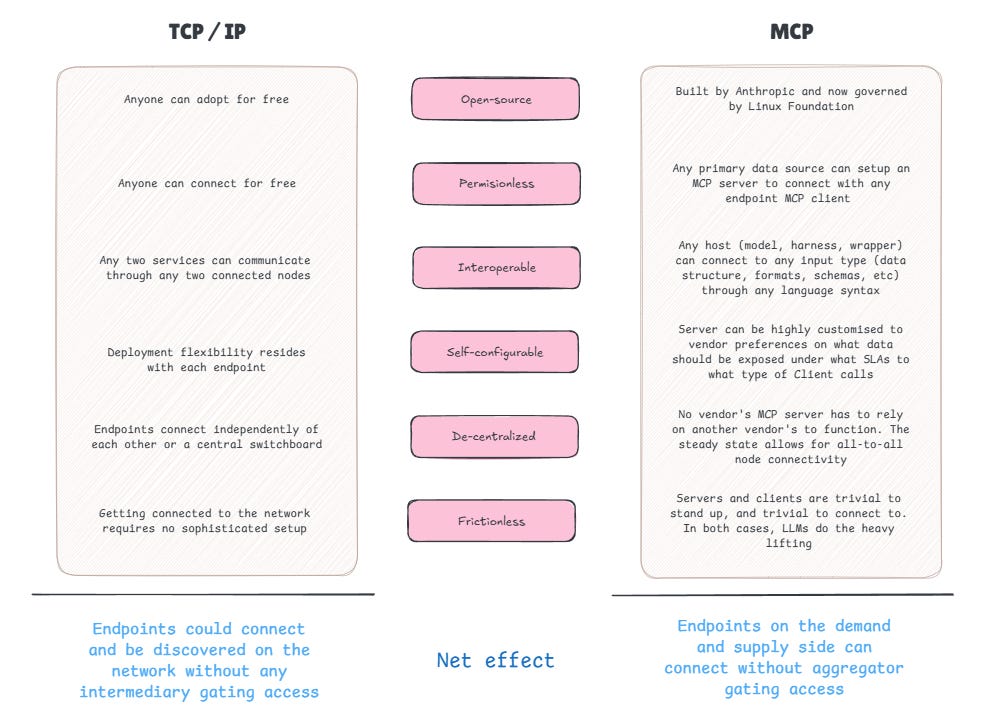
But MCP also has a hidden design property whose second-order effects have been ignored. It is also permissionless. Any data source (regardless of size) can trivially stand up an MCP server to expose its data on its own terms and become semantically discoverable and invocable by an AI agent. Like TCP/IP, any two endpoints, a server (data source) and client (data consumer), can connect as long as they speak the protocol. The data aggregator is no longer the only path for smaller primary sources to reach their customers. And pushed far enough, an agent can find a dataset without a sales cycle, painful qualification, or a human in the loop.
By trivialising integration with new data sources — vendor, third-party, or internal — MCP vastly increases the surface area of data that can be commingled. It also lowers the floor for new data sources and assets to go direct and be monetised. Discoverability becomes a non-event, as MCP endpoints are centrally catalogued. And legibility improves as LLMs handle the work of interpreting the dataset and documentation, reducing the technical competence required to use the data productively. And once multiple vendors’ coverage of the same data type runs over the same protocol, they become directly comparable and switchable in real time.
MCP led discovery and legibility are doing to the terminal what the open web did to the carrier-gated phone. Direct access to the end consumer. MCP allows an aggregation vendor’s third-party suppliers and complements to reach the target user directly — server to agent, with no aggregator intermediation standing in their way. A supplier MCP, once built, is callable by any coordination layer that wants it, not bound to whichever platform first integrated it. No coordination layer needs to win the supplier relationship to use their data, and no supplier needs to bet on which platform will become dominant before connecting. Data exclusivity in distribution becomes a thing of the past. As the technical and commercial barriers to going direct drop, a Cambrian explosion of data sources and services follows.
When every dataset is reachable by an agent-user, a coordination layer is necessary above the terminal and feed. Acting as connective tissue that provides a single interaction surface for asking questions across all of a firm’s data, regardless of vendor. One that can manage the efficient exchange of context and value among sources, datasets, agents, users, and customers. That’s value creation that the terminal cannot offer.
But offering what the incumbent cannot isn’t sufficient to invert the power dynamics. If it were, BlackBerry would have won the smartphone wars. Blackberry pushed the mobile stack to its physical limits. It failed at rethinking the stack itself.
---
The iOS and its App Store were the most powerful coordination layer to exist because they rethought what the stack could be. It didn’t just grant permission to publish — it changed what publishing required. The SDK and toolchain meant that a developer’s job was the app itself: the platform absorbed the substrate-level problems such as security, memory + process management, event handling, and system performance. Against the device, the iOS platform abstracted away hardware complexity across chipsets, memory, circuit configurations, and sensors. To the developer, it became the control plane between the device and the app, allowing a single dev to build something production-grade because the hardest parts had already been solved.
And that same control plane managed shared primitives between the user and the app: camera roll, location, contacts, notifications, payments, and identity. Once built, they could be handed to every app on the platform, subject to the user’s permission. A common primitive base allowed apps to proliferate on features. The platform’s value didn’t grow by addition, app by app; it grew by combination. One let you take a photo, the other put a filter, another published it, till eventually one app collapsed it all. Each new primitive multiplied what every existing app could do, and new apps arrived ready to draw on everything built before it, creating modular, stackable, iterative value.
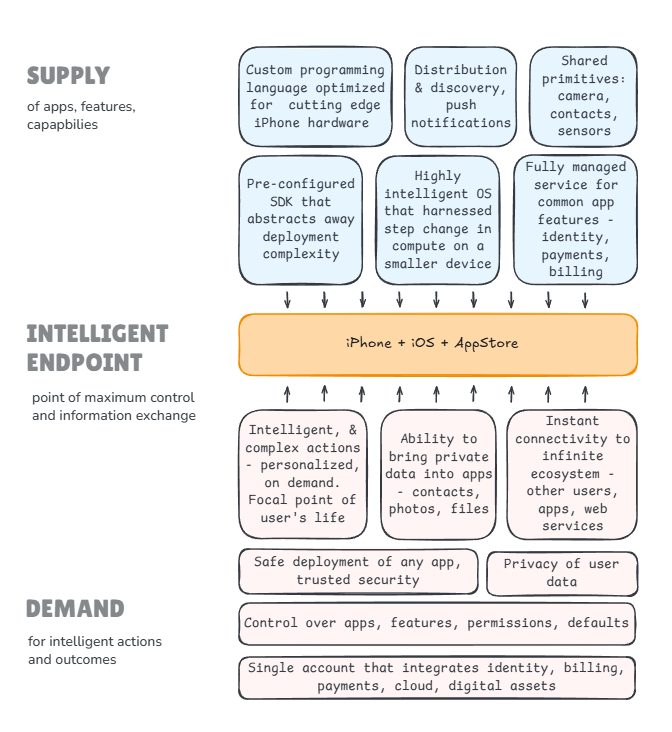
Getting to such a powerful position first requires breaking free of existing industry constructs by integrating OS and hardware while pushing technology to its first-principles limit to bring touchscreen, GPS and camera as first-class features. Pair that with a new model for value capture by integrating identity and payments, allowing consumers to safely access a variety of apps built by external developers, and ecosystem value explodes. Such an ecosystem-scale unlock is the activation energy required to restructure the old value chain into a new and better form. For Apple, the iPhone was the wedge, iOS was the mechanism of control, while the App Store scaled the value they unlocked. The telcos didn’t stand a chance even if they knew the blueprint beforehand.
A similar coordination-layer attack is emerging above the current data vendor model. The incumbents are comfortable as we’ve not reached the 3% cord-cutting stage. What they don’t realise is the one-way door they’ve opened, one that sets in motion a chain of events that will permanently upset the current power dynamics.
Claude for Financial Services single-handedly produced the activation energy to restructure the industry’s value chain. Vendors didn’t need to be persuaded to connect. They queued up. For the first time in the industry’s history, they are conceding control to a new interaction surface, for two independent reasons. Demand side pressure and technology sufficiently advanced to be magic.
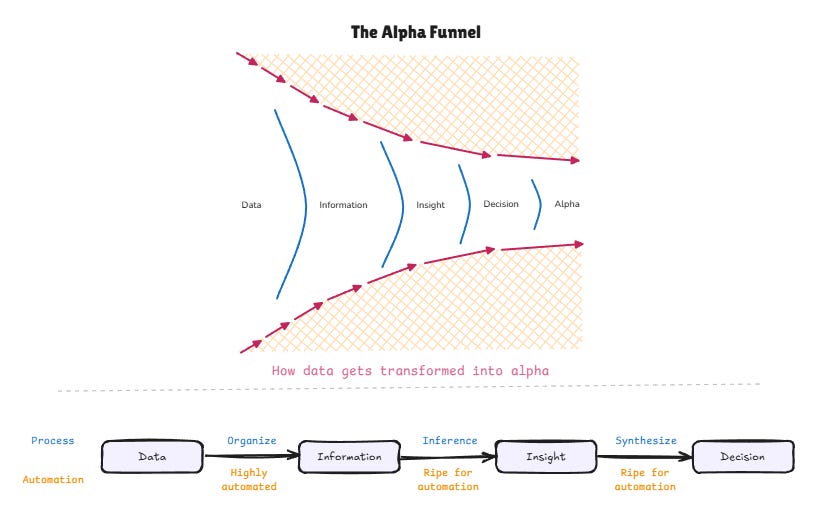
For the buy side, the hunt for alpha has run in one direction for twenty years: more data types, more history, more context. Not because more data produces more alpha, but because reducing uncertainty before a trade is the only thing the buy side controls. A single annual report tells you less than ten; ten reports less than with sector commentary and expert transcripts. More data tends to increase the potential for insights, and data consumers cannot ignore a source they perceive as relevant. Once it exists, not consuming it can be a risk.
The sell side must consume more data to provide leading research and analytics to the buy side, whose appetite continues to grow. And it must consume more data to defend whatever edge it has left: not just against peers, but increasingly over the clients it serves, many of whom now have direct access to the same raw inputs. Neither side can afford to reduce data consumption.
For decades, the industry grew by serving this dynamic. Each vendor attempted to be the most complete aggregator, first of datasets (bonds, equities, FX, news), then analytics and functions (indices, benchmarks, research), and connected workflows (trade execution, RFQ, chat). Each walled garden aggregated faster and more widely than the next, until they became indispensable. But widespread adoption meant that information asymmetry eventually migrated outside its walls. No walled garden, however large, can ever be informationally complete. Hence, every buy-side shop has tens, if not hundreds, of data sources (aggregated through a handful of vendors) it must reason over to find an edge.
Demand-side pressure is now forcing the next round of aggregation, above individual vendors’ walled gardens. Competition on the buy and sell sides was always implicitly based on access to information. MCP makes commingling of data from across multiple sources table stakes, giving consumers novel control and functionality that didn’t previously exist. But demand-side pressure alone can’t break old industry norms. It needs some magic.
---
The last half-century has calcified zero-sum thinking. Data was designed to be non-cooperative and non-interoperable, and hard to port across walled gardens, both technically and legally. Till sufficiently advanced technology brought down both those barriers.
The first to come down was legal leverage. Historically, a cross-vendor layer between incumbents and their customers was impossible. Incumbents had an arsenal of legal clauses to prevent anyone from even attempting to aggregate data as a third-party vendor on a new work surface. In the off-chance that an innovation wedged its way in and gained traction, it was acquired or copied.
LLMs were not one of them. The intelligence gains available at a query level were too large for a data aggregator to withhold access on legal grounds and remain competitive. Vendors knew their users always wanted more intelligent endpoints. But the current stack had reached its limit, and data vendors could not admit they’d spent the last decade iterating on the fringes, pretending to make smarter terminals. When an exceptionally powerful technology came along, most vendors could not explain how it worked, let alone consider building or acquiring one. It left only one decision on the table, the same one AT&T faced with the iPhone. Partner or be left out, legal clauses be damned. Vendors that connected to the new interaction surface would be first to lay siege to the new markets it would create. They all signed up collectively. Exclusivity was impossible because of the next barrier that fell.
Integration complexity. Previously, building and maintaining bespoke integrations across heterogeneous vendor systems was a multi-year undertaking in its own right, prohibitive enough that no one did it at scale. It required official vendor support - APIs, documentation, technical support, integration consultants - and a matching set on the client end. MCP collapses both sides. Standing up MCP servers and clients is trivial thanks to coding agents. In fact, it’s so easy that you don’t need official support from the vendor either. As long as their API documentation is available, anyone can set up an unofficial MCP server (as has been the case for Bloomberg). Alternatively, clients can write their own private version of a vendor server for internal use as long as it maps to the vendor’s existing APIs and usage policies. That simplicity for clients to stand up unofficial servers meant vendors had no choice but to offer their official MCP server for enterprise-scale service. Not doing so would also have ceded the only control point available in the new stack.
The collapse in integration costs changes what is possible. MCPs move from being just new access mechanisms to enabling new ways of consuming data. In one fell swoop, it standardises discovery (what’s available), interpretation (what it means), and execution (how to retrieve and use it) into a single message an agent can act on at runtime. No advance mapping of what’s where, no pre-training required on how to use it. A few simple files and rules do all the work.
Without integration friction, the demand side imperative necessitates cross-vendor aggregation. All it needs is an intelligent orchestration layer, disguised behind a harmless new interaction surface, to provide the connective tissue. One that can stack separate levers of value creation into a single vector, on a scale equivalent to delivering the iPhone, iOS, and the App Store.
---
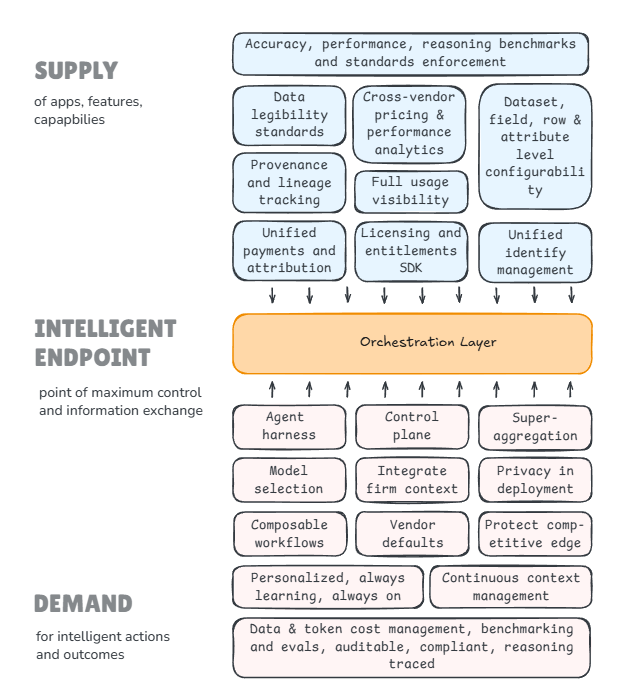
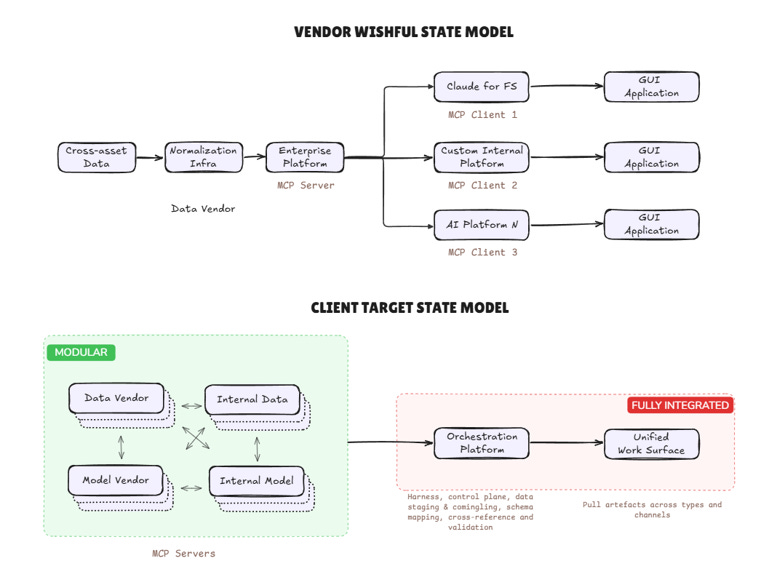
The emerging orchestration layer does three things at once, each a distinct form of value.
Super-aggregator: a single interface that aggregates across every vendor a firm already subscribes to. Every MCP connector is a ready-to-use plug that the orchestration layer pulls in. This solves the question: “Can I see everything I’m already paying for, in one place?” It compresses the time required to stitch data across sources, reducing it from weeks or months to instantaneous access.
Harness: making that aggregation productive by packaging SOTA models tuned for financial workflows, embedding industry-specific reasoning capabilities, offering model-provider flexibility, enabling citation and reasoning audits, and providing ready-made skills and workflows that compress hours of manual work into a single instruction. This solves the question: “Can I do more with the data I’m already paying for?” The harness compresses the time-to-value of synthesising and reasoning, reducing it from hours and days to minutes.
Control plane: permissions, entitlements, governance, and routing decisions now move to a single surface that mediates three key relationships: between sources and their clients, between clients and their users, and, finally, between users and their data. No prior architecture supported three relationships in one place; this one can, by default. This solves “Can I use all of it, safely, correctly, and maximally to my advantage?”, compressing time to deployment, setup, and scale.
Claude for Financial Services is the industry’s iOS moment. The hardware of the device that the user interacts with is virtualised in a data centre; the user only needs to access the interface - Chat or Claude Code. The same infrastructure also virtualises the software that manages the intelligence: deploying agents, running sessions, managing context, connecting with external tools and data. And the data (app) store allows you to connect to any vendor, of any size, for any specific niche content you may need. The industry’s iOS moment is only overshadowed because the press is busy following aggregation vendors who are pursuing BlackBerry-like outcomes.
Existing vendor deployments of AI capabilities are constrained to old paradigms. “Summarise this”, or “explain that,” or “identify why”. This stems from thinking only within the walled garden and from viewing data as discrete artefacts that need compression rather than connection. The true power lies in releasing AI over a large, well-described data volume to find connections and reasoning that humans themselves would never arrive at.
An intelligent orchestration platform should help make answering the following question frictionless: “For which companies in the power and transmission sector are sell-side revision commentary, management’s language on earnings calls, and what experts at peers are saying not fully aligned?” Answering which requires tasks spanning different data types across different vendors. The agent pulls the relevant data from across vendor specialities, reads tone and language in the qualitative sources against the direction of the quantitative revisions, and surfaces the names where they disagree as the signal worth investigating. A user can immediately prompt the agent to analyse why this might be the case and to recommend possible frameworks for assessing and weighting these differences in decision criteria. All in a matter of minutes. Not to run once, but to run in a loop that updates findings based on new information that comes to light from Semianalysis or podcast interviews by the mavericks building the future.
Multi-source, multi-type access without the reasoning to weigh the commentary is just five open tabs; the analyst still has to notice the divergence by hand. Reasoning without cross-vendor access has nothing to compare. A single vendor’s data, however well an LLM reads it, is limited input. The combination, for the first time, makes the divergence visible at all. This single output spans multiple vendor agreements, each scoped to a different field, product, and delivery mechanism, none of which include a clause for a workflow that weighs them against one another. There is no output price for what the agent did because there is no unit of measure for its value, and no certainty around the path it takes to get there.
What an agent decides to pull together for a query can vary by prompt, user, context, access, model, and other upstream and downstream factors. The use case is unlocked precisely when source composition is allowed to be unpredictable. Variability is the prize, despite how revolting the concept sounds to those intoxicated in financial dogma6. Thankfully, they don’t have much say in what comes next.
Deploying LLMs inside the old licensing architecture is like building a rocket engine and bolting it to an airplane: the engine works, the plane goes faster, but it never gets anywhere a propeller couldn’t have reached. Only by breaking the old regime can the ecosystem-scale lift the industry so desperately needs be unlocked.
All prior access to financial data was intentional, spec-constrained, and wired to known workflows. A human or system requesting a defined dataset in a fixed format as anticipated by the contract. The entity and activity were always legible.
MCP changes both the activity and the actor. Unlike humans, agents discover capabilities at runtime and compose workflows as needed, categorically different from faster or higher-volume versions of the old pattern. Consider a fixed-income manager using an agent to assess a leveraged copper miner’s debt raise on a supercycle thesis: commodity price curves, covenant details, competitor KPIs, expert network colour on ore grades, sell-side and niche-sector commentary. Six source-types, rarely from the same vendor, composed only as the reasoning develops. No contract anticipated that composition; no entitlements workflow was built to govern it.
Every prior shift in the consuming entity (from analyst to quant, from human to algorithm) preserved one critical property: the consumption pattern remained predictable, observable, and therefore billable. An agent composing a cross-vendor workflow at runtime has none of those properties. Treating an agent as a new category of authorised user is a pointless exercise when you cannot predict what it will consume. MCP’s value is exclusively in the unscripted case, where the data path is discovered mid-reasoning. Existing terminal endpoints aren’t designed to handle new consumption patterns & ‘binge-watching’.
The demand-side pressure from high-value unscripted consumption does not resolve through renegotiating licensing terms. It resolves through routing to niche vendors not constrained by licensing dogma. The orchestration layer makes this possible, as MCP trivialises the cost and complexity of cross-vendor comparison.
---
For comparison to be a first-class feature, it must be frictionless. MCP allows data to be read from wherever it already sits and for outputs to be assembled on a new surface. Client, vendor, and third-party content don’t need to move across cloud estates or get re-uploaded to a common store. The orchestration layer connects to each source directly and works on it in place. When data never has to move to make a source reachable (an LLM can read a file directory and crawl a server space), connectivity becomes frictionless and the available data supply multiplies.
The increase takes two forms. Vendors will be able to make more data available to a single agent (for processing) than to a human, increasing the scope for composition. And each dataset type will have multiple vendors for an agent to choose from, increasing substitutability and switching. Together, they introduce new interaction patterns.
A portfolio manager at a firm with contracts across five or six vendors has always had nominal multi-vendor access. They have never had coherent, cross-vendor query capability. The orchestration layer delivers that from the first session: the agent selects the most appropriate data source for each component of the query, surfaces methodology and schema differences from vendor documentation, and returns a synthesised output composed across the best of each vendor. The manager can then redirect with a plain-text instruction: “Rerun using LSEG’s WMR for FX, FactSet for earnings, and add texture from GLG transcripts.” The switching decision that previously required months of evaluation, stakeholder sign-off, and integration work now happens at the query level, in real time. But the user-directed case surfaces an open question that the autonomously directed case makes unavoidable: when the agent selects sources without an explicit instruction, what governs its selection mechanism, and how is agentic bias managed? The terminal vendor cannot influence that governance choice. Only the super-aggregating orchestration layer, can solve that.
The terminal’s moat was never just the data. It was also the cost of switching away from the interface that organised access to it. A cost that lived in integration work, retraining, and workflow dependency, quietly conflated with the data’s own value. MCP leaves the data alone and dissolves the integration work that made switching expensive. Strip the interface moat, and each aggregator vendor faces a market it was never designed to compete in: undefended by the walled garden, judged purely on its merits, its data visible, comparable, and a single agent call away from being substituted by a cheaper source that delivers performance parity. And with more data sources incentivised to do direct to customers, that substitutive threat attacks the foundations of the old licensing regime.
---
Once enough vendors become invocable via MCP, the licensing regime they operate under has no choice but to move. The sheer availability of options forces a cascade. The fringe moves first. Vendors like Daloopa (AI-structured fundamentals), Quartr (earnings call transcripts), Fiscal AI (KPI and performance metrics), and Estimize (crowd-sourced earnings estimates) own their data outright, so no upstream licensing terms constrain what they can offer. Their datasets are composable and licensed permissively out of the box. They don’t need to restrict how users attempt to derive value out of their data through agentic use.
As composability compounds and more such vendors connect, the orchestration layer-mediated coverage becomes more composable, and every additional dataset makes the next vendor’s absence more conspicuous. The orchestration layer is inherently incentivised to attract and promote permissive-licensing alternatives, aggregating niche vendors that offer substitutes across data types for smaller buyside clients with urgent cost-control targets to meet. Once permissive new vendors establish performance parity with restrictive incumbents, licensing flexibility stops being a backend detail and becomes a front-line purchasing criterion. The question a buyer asks shifts from “whose data is historically trusted” to “whose accurate data can I actually use fast, in a way that gives me more value?”
The flywheel sets off a data accretion sequence, with a critical mass of permissive datasets arriving faster than any individual vendor’s onboarding decision would suggest. The hinge event would be the first large vendor to publicly acknowledge that the existing licensing architecture cannot govern agentic consumption and to offer alternative terms in its place. That single concession re-trains the market’s expectations. Every subsequent renewal, across every vendor, now starts from a baseline assumption of permissive licensing.
Licensing freedom without pricing flexibility is a dead end. Luckily for consumers and agents, the industry has self-adopted its own unbundling vector.
---
Faced with a consumption pattern that the old architecture can neither price nor govern, the industry’s reflex is the same everywhere: introduce consumption-based pricing.
But consumption-based pricing has a cost that incumbents pay and challengers don’t. By design, you pay for what you consume, which means breaking out pricing by component rather than selling a single negotiated bundle. A transparent, per-component price gives every customer a real-time signal of what they used and how much it cost, and anyone who can see that number can infer how much the opacity in their old contract was worth. Seat-based and volume-commit pricing worked precisely because the bundle let genuinely proprietary data carry the rest at an inflated composite rate. Price each dataset individually, as consumed, and it must justify its cost against alternatives that are now visible, permissive, and a single agent call away.
Incumbents introducing consumption-based pricing position it as margin or revenue expansion. But given the disaggregation dynamics already at play, that expectation relies on false assumptions.
First, the assumption of who captures proportional value. Consumption-based pricing assumes increased agentic usage converts proportionally into monetizable revenue for the vendor whose data is used. The telecom precedent says otherwise: carriers metered and billed by the megabyte for years, and consumption exploded with the smartphone, but carrier revenue and margins did not grow in proportion. The growth accrued instead to the layer that orchestrated how people used the data they consumed. The same outcome is likely to repeat here: a vendor can sell more individually metered API calls while still losing pricing power. Both because MCP attracts dataset-specific competition, intensifying price rivalry, and because a good orchestration layer doesn’t sit idly by. It optimises requests down to the minimum necessary data pull, while ensuring the output is what is reasoned over multiple times by downstream higher-order workflows.
Second, the assumption claims legitimacy it never had. Licensing has always governed the artefact — the dataset, the feed, the field — to police a different threat: a customer reselling, a vendor redistributing without attribution. It never reached into what an analyst does in their head, how they compose what they’ve read into a conclusion. Consumption-based pricing aims to tax agents in a way that never taxed humans pulling the same data. What changes is frequency, and end consumers have grounds to push back simply by architecting around it.
Third, it ignores the trade-off for the client. Consumption-based pricing turns a fixed-price contract into a variable one, the opposite of what most FS clients want during unplanned, runtime consumption. The appeal is unlocking agentic value with cost certainty, not cost exposure. Data budgets have to share space with token budgets, and the orchestration layer is where that gets managed.
Fourth, it ignores how price decays. Arriving at consumption-based pricing requires modelling expected consumption to determine a starting price. Agents are autonomous and self-learning, meaning that consumption can’t be predicted. They could quickly learn that company fundamentals change only every quarter and redirect regular pulls to memory or to archived data from previous pulls. Agents could identify low-refresh data to share as context with other agents, rather than having each agent pull afresh. User-agent pairs can create reusable work products that reduce the fresh-data needs of the next user-agent pair and produce analysis that no single vendor could contribute to in isolation. Commercially, no agent-specific seat, tier, or volume band maps to any of this. Whatever pricing bands a vendor launches with can be quickly weakened by the agentic capabilities working against it.
Ironically, agents are meant to mirror human workflows and activity. If human activity was not priced per query, why is agentic access being priced that way? Push any incumbent CEO hard enough to answer why they’re reinventing the commercial model, and you’ll get to the heart of the decaying philosophy the industry assumes is its right - taxing the efficient transfer of information. The orchestration-layer stands to challenge that. MCP is the Trojan horse that precipitates a coordinating function above the point where vendor meters sit, leaving them no room to see, price, or govern. All the while, data vendor incumbents remain convinced that their containment thesis is valid, just as telecom executives were when Apple built around them.
Agree or Disagree. Don’t leave without a comment.
Act III — The Unravelling
The carrier case study provides another parallel. Why informed, well-resourced executives still couldn’t see what was coming until it was too late. That requires a different kind of analysis: not the mechanics of the industry but the operational priors and cognitive biases of the people running it. The carriers’ confidence going into the iPhone deal rested on five beliefs, which were all reasonably true up to that point.
The first was that the network itself was the irreplaceable asset. Building a wireless network required capital at a scale only a handful of firms could marshal, plus territorial spectrum licences that were, by design, exclusive. Nobody builds a second nationwide network to compete on price. Next, direct billing secured the relationship. Whoever owned the customer’s bill owned the customer. A carrier’s contract controlled access to the device, determined which apps were included and how much you paid for data. No outside party could insert itself into that relationship without the carrier’s consent. Third, the deck was proof that carriers govern all value created on top of the network. Value-added services and content providers entered into revenue-sharing agreements with carriers for distribution, proving that the carrier’s leverage in the ecosystem could extend and capture a share of anything built on its rails. Fourth, that smartphones would expand the carrier’s pie. That more capable phones meant more data plans, higher attach rate, and more revenue per user that would, proportionally, flow into the same revenue lines the carrier already owned and metered. And finally, a belief that whatever new thing emerged would stay in its own lane. New distribution, new devices, new app ecosystems. All of it was assumed to operate in a separate plane from the carrier’s existing revenue. Additive rather than substitutive.
Every one of these beliefs was the correct read of the world as it had existed for the prior two decades. Nothing suggested it wouldn’t continue. But the inability to update priors is an ailment that strikes a particular kind of executive. Most likely to happen when the competence of those building the new value layer differs in kind rather than in degree from those who built the last one. Carrier execs didn’t have the analytical tools or mental models to understand how dramatically their command over their ecosystem was eroding.
The first belief fell to a protocol they didn’t fully appreciate. The new layer never substituted the network; it bypassed the network’s ability to differentiate the value passing through it. The second belief fell when the relationship itself changed shape. The iPhone and the App Store didn’t take the billing relationship away from the carrier in any visible, contestable moment. It became the place the customer went first, for everything except the dial tone. The next fell because governance requires visibility, and the new layer removed exactly that. Once apps could be discovered, installed, and paid for through a layer the carrier didn’t operate, the carrier’s commercial architecture had nothing left to attach to. New voice, messaging, and VAS products stopped being routed through the carrier’s field of view. The fourth belief fell because the expanding pie had a different owner. The proliferation of smartphones did expand the addressable market enormously but growth flowed overwhelmingly to the scarce platform that mediated between the device, the users and the developer. The carrier was reduced to selling the data pipe through which the new value travelled. The final belief fell as the new layer increased competition in the old. Incumbents were not technically equipped to see how the new layer could introduce substitutive alternatives that were a significant feature and price upgrade to what the incumbent stack could offer.
Each of the erosions, examined alone, looked survivable: a network commoditised here, a relationship reshaped there. The belief that these would stay siloed let each individual erosion feel like a containable event. The failure to see their blind spots converted isolated events into an unstoppable cascade.
The same outdated priors run through the financial data industry.
“Our core data is non-substitutable.” Decades of investment in collection, cleaning, normalisation, and distribution gave the sense of a durable moat. But that moat rested on comparability. An agent that queries three vendors for the same field and compares the answers and respective documentation in real time does what no analyst had the patience to do by hand: makes equivalence checkable. Once equivalence across substitutes is checkable, price competition follows where substitutes exist. For most financial data, two or three vendors compete on comparable offerings. Genuinely single-vendor offerings with no comparable alternatives are rare and, by definition, TAM-limited.
“Customers still have to contract with us directly for data.” Vendors treat the enterprise licence and named-seat terminal agreements as the wall. Right, that the relationship is direct and real. Wrong about what it still controls, once a layer above becomes where the analyst works from. A sufficiently capable orchestration layer runs benchmarks, validations, cost controls, and API calls from above any single vendor’s product, and becomes the analyst’s first stop for everything. The vendor isn’t removed from the chain. It’s repositioned lower, from primary relationship to interchangeable backend, selected by the orchestration layer’s logic rather than the analyst’s habit.
“Our licensing and entitlements architecture governs every byte of data.” Rights management, redistribution clauses, and usage-based tiers are all designed to exert microscopic control over data, extending to capture whatever’s built on top. But governance requires visibility, and the new layer removes it for the new outputs it creates. Insights and synthesis are higher-order artefacts produced as agent queries, reasons, and discards. It doesn’t copy or redistribute the source data, so it doesn’t trigger any of the clauses written to govern such activities. The old licensing regime was built on the old stack which could monitor data access. But the new stack generates insights, activity that the old stack has no means to detect.
“AI and MCP expand our addressable market proportionally. More consumption of our data, on our terms, at our prices.” Metering captures volume, not pricing power. Agentic adoption is genuinely growing the pool of consumption. But MCP’s second-order effects of data supply abundance and price competition mean value is captured by what is scarce. A modular, feature-rich, custom-deployed orchestration layer that integrates firm context and runs evals autonomously to improve outputs becomes the scarce asset positioned to capture the expansion.
“Whatever new value MCP creates operates in a separate plane. It cannot erode the channels we already monetise.” Each dismantling above is a precondition for the next: once equivalence is checkable, the control plane assembles the analysis itself from whichever sources are cheapest, bypassing the vendor’s interface and leaving its licensing architecture unable to tax new value creation. The market has always paid more for synthesis than for the inputs synthesis runs on. A buy-side analyst’s research call commands a premium that no raw feed does, because the analyst, not the data vendor, has always sat at the end of the chain doing the packaging. The orchestration layer is now where that packaging from across sources happens, and it inherits the premium synthesis has always carried.
The compression of the distribution layer to earn that premium will not happen visibly. Data aggregators will feel safe in their containment thesis. And as long as product launches, pricing pivots, and earnings calls are filed under the wrong heading, incumbents will have cover. But as soon as the orchestration layer starts flexing its positional power to incentivise competition and co-building, that cover disappears.
---
Trying to build every app itself would have been a strategic error for Apple. The App Store’s masterstroke was a three-way win: developers reached a distribution base no one of them could have assembled alone, users got more functionality faster than any single company could ship, and Apple captured a cut of value it never had to build. A well-designed orchestration layer compounds value similarly: the layer gains nothing by trying to build every data integration, every workflow, every reasoning capability itself. Plenty of that work is better done by specialists. The layer only needs to build the few core modules and shared primitives that apply to the widest possible user base, and incentivise everyone else to bring their capability through it.
Once that incentive structure is in place, the layer ignites a few distinct network-effect loops. First, more developers mean faster delivery. Each new supplier or workflow builder who joins increases the rate at which new functionality ships, without the layer itself having to build it. Second, cross-proliferation of models (SOTA and open-source) with integrated context can push financial reasoning beyond what siloed vendor-tuned LLMs can. Making the orchestration layer uniquely positioned to improve financial reasoning outcomes per client. Third, as the layer accumulates cross-vendor composition habits7, it begins to produce insights that no single vendor’s terminal could generate alone. Each new feature, reasoning gain and insight category attracts new users, whose usage, in turn, funds the next acquisition or capability, compounding the loop. As these loops compound, the orchestration layer’s own representation of what data means and how it relates to each other becomes the standard. First-mover advantage is hard to dislodge because it isn’t just about market share. It’s the layer’s growing claim to dictate how value gets reallocated to everyone plugged into it.
The orchestration layer’s neutrality is short-lived once escape velocity is achieved. The entity that owns the winning layer has an active incentive to accelerate the commoditisation of the data layer beneath it. Its value rises as the data sources underneath it become more interchangeable, more transparently priced, and more freely composable. It does so through specific design choices.
It reviews. Instead of collapsing different vendors’ answers to the same question into one normalised output, the orchestration layer can surface what each says, and how they got there, side by side. It remembers. Every comparison adds to a running record of which vendor’s approach has proven more useful for which kinds of questions over time, and that record becomes the basis for optimised routing, a service only the orchestration layer can provide. It recommends. Once that record exists, cost and demonstrated value sit side by side, and a vendor whose distinctive approach isn’t worth its premium, or whose “commodity” data costs more than an equivalent, has nowhere left to hide. That transparency, combined with user feedback, builds a recommendation engine across vendors, data types, and fields.
None of this requires malice or a grand plan. Each feature is also just a better product for the end user. The orchestration layer doesn’t need to choose to commoditise its complements so much as it can’t avoid it. The data vendor, in effect, actively supplies the raw material for its own commoditisation.
Bloomberg’s countermove now makes sense. They see the value in keeping the orchestration layer in-house, holding onto the philosophy that got them this far. Build, don’t buy. Protect the walled garden and business model. Adapt only what needs to survive human or agentic use. Having seen the chessboard, they are making some early sacrifices. Bloomberg has built ASKB, an in-Terminal agentic system running on a mix of commercial and open-weight models while (still?) training its own proprietary model8. These won’t be without defects and will lag behind independent orchestrators for a while. But it’s the only available move when all its peers have caved, and it’s a necessary cost to build differentiated learning loops that are essential for future value creation.
Shipping a public MCP connector is low-cost and immediate. It ticks a box for the board and positions any vendor favourably with investors willing to believe any AI tag. Bloomberg, answerable to no public market and no quarterly report, took the slower route: deploying MCP as middleware, for internal agents to exchange context, which never leaves the terminal. Only by developing independent capabilities can they protect themselves from demotion in the value chain.
Bloomberg knew first-hand how new protocols can demote incumbents. Three decades ago, it used TCP/IP to win the first terminal wars against Reuters. TCP/IP allowed Bloomberg to utilise third-party leased lines to quickly expand its terminal footprint and develop its network architecture in a capex-light, routing-efficient manner without ceding control. Reuters, which had spent decades investing in its own physical lines and client-side-deployed hardware, could not keep up with the capex required to sustain its model. Its infrastructure became too complex to be managed productively and competitively, resulting in years of repeated misfires. All while Bloomberg expanded at breakneck speed.
Bloomberg correctly adopted a disintermediating protocol once to win. Back then, its current CEO was a junior engineer watching TCP/IP transform the technology landscape. That experience may just have inoculated them against the blind spot that other industry majors face and likely provided the mental model to zig when others zag. Bloomberg’s move is the only defensive play available. But it doesn’t mean it is the right one. Pulling it off is a whole different ball game, and yesterday’s announcement shows how little progress they have made9. Backed by patient, founder-controlled capital, a bet this risky is worth pursuing only if undertaken deliberately and with a full view of what competing orchestration platforms, with the combined data gravity of all competitors, will enable beyond their walled garden.
The most charitable read of the situation is that S&P, FactSet and LSEG opened their MCP servers to new AI platforms as a deliberate way to challenge Bloomberg. The more likely read is that, like AT&T, they couldn’t have known better. Act IV offers a tell and a promise.
Act IV — The Reckoning
Listed incumbents can’t publicly acknowledge when their position in the value chain is being challenged. Any acknowledgement would lead to a stock price crisis. So any well-resourced incumbent, out of necessity, has to reach for misdirection. The playbook is not new. Between 2005 and 2012, as the internet and smartphone era made telco commoditisation first possible, then unmistakable, the same pattern played out.
In 2005, AT&T’s predecessor CEO Ed Whitacre told BusinessWeek: “Now what they would like to do is use my pipes free, but I ain’t going to let them do that.” Whitacre preached from what he thought was a position of power, unaware of his lack of it. TCP/IP meant that Google, Yahoo, Amazon, and BlackBerry could all use AT&T’s network to reach their customers without paying AT&T a dime. Ed may have been aspirationally right about what AT&T was due, but he was categorically wrong (or in denial) on what levers he had to accomplish it.
By 2009, as the iPhone was restructuring the value chain, Verizon’s CEO Ivan Seidenberg told SUPERCOMM: “The truth is, we have never provided dumb pipes, [...] customers will rely even more on the [...] product differentiation that network operators provide” Seidenberg had convinced himself or was trying to convince his investors that carriers had a product to differentiate on, and could not be considered dumb pipes.
By 2012, AT&T’s CEO Randall Stephenson told the Milken Institute that iMessage was disrupting messaging revenue, and that “My only regret was how we introduced pricing in the beginning, because how did we introduce pricing? Thirty dollars and you get all you can eat. Every additional megabyte you use in this network, I have to invest capital.” Even as Randall was capitulating to their position in the value chain, he misdiagnosed (or misdirected blame) that he could have avoided the outcome by controlling pricing. Even with a fixed cap on data usage, he knew full well iMessage was going to kill SMS.
Whether these were disingenuous or sincere does not change what CEOs must do. It matters not which industry; their playbook cannot allow them to concede. But there is a tell in their answers, a pattern to their defence. They defend the asset and ignore responding to the position.
The financial data industry has been using the same playbook consistently, claiming high-quality content, trusted data, licensing rights, integrated workflows and customer relationships. None are false, but none clarify where these assets are moving to in the value chain. The litmus test of these responses encountered in the wild is simple: does their response say anything about where value will sit and who will control access to it? Or does it redirect the conversation to the assets the incumbents control under an old regime they believe will exist indefinitely?
The common refrains easily crack.
“Our data is trusted, and trust doesn’t switch”. In the short run, the orchestration layer requires no one to change vendors; it sits between vendors and customers and lets vendors compete with each other. In the long run, the relationship is tested, and the trust benchmarked. Trust that was built on an assumption of quality was never externally compared. The orchestration layer pits one vendor’s reliability, refresh speed, coverage, or error rate against another’s, allowing a new generation of vendors building high-quality data products to compete on objective performance rather than perceived brand premiums.
“Our workflows are deeply integrated”. Deep integration is a function of how expensive it was to build workflow logic. A record of sunk cost, without assessing the current barriers to replacement, particularly when connecting with a new tech stack. The carriers’ deep integration and gating of dumb phones and their OS were irrelevant to defending against the new stack Apple was building.
“Probabilistic models won’t get past regulators”. Non-determinism does not make agentic workflows un-auditable. An agent reads, reasons, and discards data the way a human analyst does. And agents are as probabilistic as humans are. Given the same input information, we can derive a bell-curve of possible interpretations. Regulation already accounts for that distribution of human actors. Policing agents is the same problem at a granular scale applied to a faster actor that, unlike humans, can self-document every decision.
“We’ll price for MCP access”. A vendor building pricing infrastructure around MCP has accepted that value is leaking. But charging a premium for MCP as a standalone product misattributes value. It makes the same mistake the carrier made, which thought the move from 3G to 4G was a pricing opportunity. MCP is a technical upgrade to the API for the agentic era. That’s a feature addition expected from a price increase, not grounds for stand-alone pricing. Convincing existing clients to pay for a new delivery mechanism for the data they already consume via feeds or a terminal quickly hits a wall.
Laid end to end, these arguments describe something their spokesperson would prefer not to acknowledge. The first doesn’t engage with the mechanism; it defends the asset. In the next two, the mechanism is accepted; the question has become pace and roadblocks. By the end, the position itself is conceded, and the misdirection shifts to how to capture value. An industry cycling through this arc appears to be pushing back against the thesis, when in fact it is trying to hide a most troubling truth. That they are experiencing positional displacement. That their existing products are being disrupted by new interfaces that can do more with data. That they are losing on both bundled and consumption-based pricing. And that, taken together, their power within the value chain is being disintermediated outside of their control.
As with any industry-wide disintermediation cycle, the enticing prospect for everyone else lies in figuring out what the new stack looks like and who builds it.
---
In Distribution 1.0, distribution was bound to the vendor, each vendor managing its own channel to its own customers. In Distribution 2.0, distribution decouples from any single vendor and becomes a property of the orchestration layer sitting above all of them. One that newly concentrates information supply and demand on a more intelligent surface. That decoupling changes who can participate.
The App Store’s bigger story wasn’t just that Apple and Google became the two winners. It was what happened through them. An explosion of developer-built apps that had never been economically viable before followed, and a meaningful number of them became enormous businesses in their own right. Uber, Instagram, Spotify10, and thousands of smaller ones.
In Distribution 1.0, reaching a user meant arriving bundled with a vendor’s commercial relationships, entitlements infrastructure, and sales motion. A floor high enough that most narrow-but-valuable datasets that never reached critical mass got absorbed as features inside someone else’s product. In Distribution 2.0, that machinery is reclaimed: a dataset, a workflow, or a tool reaches a user through the orchestration layer and only has to clear one bar — competing to win an agent’s query, unhindered by a lack of scale.
Every asset owner in this story competed on the same logic: economies of scale. Bigger network, bigger dataset, lower marginal cost, more pricing power, the moat deepens the more you own. The orchestration layer runs on a different curve. It gets more valuable in combination as more vendors and workflows connect, because each new source makes every existing one more useful to compare against, route around, and compose with. That’s economies of scope, compounding on top of economies of scale. A layer that becomes cheaper per unit while simultaneously becoming more valuable per combination is rare. That double inflexion is why the shift from Distribution 1.0 to Distribution 2.0 will reshape financial market infrastructure.
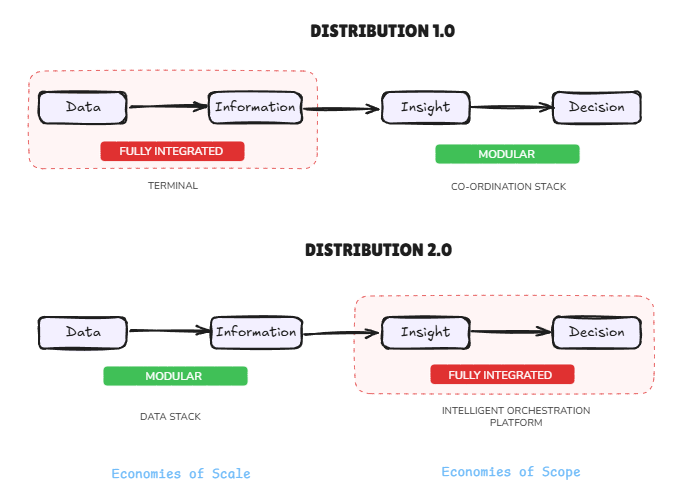
Claude for Financial Services is the opening gambit of the orchestration layer. An iOS v0.1, if you will. Proof that the new layer is taking shape, not who has permanently laid claim to it. The AI-native, MCP-enabled application layer above financial data is barely a year old, and the much larger population of companies the lower floor makes possible is almost entirely unbuilt.
None of what the orchestration layer promises arrives on its own. Switching costs don’t collapse without intelligent routing algos built off independent benchmarking tests. Routing decisions can’t be individually written against a highly fragmented vendor universe. Licensing won’t loosen till the fringe reaches critical mass. The harness cannot ship capability for every niche, every desk, every edge case. The orchestration layer cannot build all of this itself. It needs an ecosystem of partners. Everyone has a part to play.
The categories above are close to green field, and the earliest movers get to define what “good” looks like. The window for that is now, not after someone else has already drawn the map. The experienced, technically capable people currently inside the incumbents understand this market better than any outside founder ever will, and that knowledge is worth more outside the old architecture than inside it. Some will build the new layer directly. Others will be the difference between a founder’s good idea and a founder’s informed one.
Funding playbooks need an overhaul. Consolidating small vendors and exiting to incumbents was meant to add scale and bundling power. But with unbundling ahead, the PE trade now runs the other way: collecting a portfolio of credible, standalone data vendors and keeping them independent, competing on permissive licensing and openness. A unique portfolio, if correctly combined, can become the largest, most composable supplier that the orchestration layer can route to, capturing the agentic market while incumbents remain tangled in old constructs and opacity.
The problem spaces in this industry aren’t undiscovered; they are well known to insiders in almost every niche. Opacity has kept them unsolved: the industry’s problems are hard to see from outside it, and hence the technical talent capable of solving them has been drawn instead toward other industries that make their problems easier to find and solve. A concentrated VC model beckons. Back fewer bets where the solution and path dependency are better mapped, and actively pull together the talent capable of solving them, including out of the incumbents themselves. The firms that win here need deep sector specialists who can help shape the solution with founders and help them navigate the incumbent’s parries.
Even the adoption frontier needs new skills and new ambitions. Most decision-makers on the demand side are trained in outdated paradigms. Many need to be dragged into new ways of testing and deploying frontier capabilities by their reports (who should have already taken their place).
Financial market data hasn’t seen a shift like this in decades. The Terminalist isn’t a neutral bystander. It’s here to conspire and catalyse that change. To critique decay and to champion defiance. If you are actively building or looking to fund this opportunity, get in touch.
The layer forming above Distribution 1.0 is being built by people who were never part of it to begin with. The only question this essay leaves you with is which side you’d like to be on as it materialises.
The Terminalist
Follow me on Twitter or LinkedIn for short-form commentary and quick takes. And reach out if you have ideas on what to cover next.
h/t to Huss, James & Jordan for invaluable feedback and to Damian, Kirk & Stephanie for textured discussions that shaped this post
Further notes
Thanks for getting this far. If some of the ideas here resonated with you, the biggest lever you can pull next is to share this with your network. To folks at Anthropic and to Bloomberg’s AI leads. Go wider to founders and funders, adjacents in the stack, and anyone thinking about MCPs. If you have been trying to get this message out within an incumbent and few paid attention before, here is another reason to push your message up the chain. No, it won’t make a difference at the highest levels, but leave that to me; there is more coming to rid us of the bald and the blind.
The first half of this year has seen some heated funding - Databento, Daloopa, Kpler, Rogo, and Alphasense, all with blowout announcements. Each one over-subscribed and with grand ambitions. We’re just at the start of this wave, and there are plenty of new ideas taking shape. Get in touch for under-the-radar plays I’m excited about before they hit double inflexion.
The mission to demystify the industry needs more hands on deck. Writing is one of many inputs that foster innovation. I’d welcome ideas on how we can mobilise 7,500 readers to push forward better ideas and outcomes.
Substack as a platform is growing. That means my emails and essays get buried among other subscriptions. The algorithm only rewards regular posting, which sadly isn’t possible with long-form. Another way you can help is to share new posts with existing readers, not just new ones. A constant refrain from readers is that they weren’t aware a new post was out, so anything you can do to notify peers would help.
Update: a stop gap announcement was made on the eve of this post.
For carriage, not for licensing content
A protocol is an agreed series of steps to move bits of information between two nodes on a network. It governs how information is broken down into packets, how nodes are addressed, how packets are routed, under what conditions they are retransmitted, how they are stitched together at the other end, etc. Universal agreement on the protocol reduces overhead for the network to figure out logic and rules for each node-to-node connection, and instead focus purely on moving the packet seamlessly across the network.
Content is unintelligent without user context (and now intent) against it
Real-time data, in addition to being contractually scarce, is also mechanically scarce
The false equivalence the industry makes trying to defend themselves is that non-determinism of LLM models prevents useful workflows from being constructed. While at the same time lining up to provide their data alongside the labs.
And, increasingly, pre-purchases proprietary datasets specifically to sharpen its own reasoning and insights
One hopes they haven’t given up after the first GPT. Would be a shocking concession of technical ambition.
Requiring new levels of aggregation. It should come as no surprise that they have rapidly picked up their rate of partnering for new datasets.
Spotify has a lesson as well. Record labels hold real, enforceable copyrights and licensed their catalogues to streaming platforms on negotiated terms from a position of strength. Nothing was redistributed without permission; every stream had a payback. Despite their intentions, power shifted from content owners to the control and recommendation layer above them.
A big part of Bloomberg’s remaining hook is fixed income, they have the best data, they have structured it better than competitors, and they have such a strong network effect that people trading bonds will rely on it for pricing and trading even when it is wrong (and can be proven wrong). There is no single data source that can hook into any AI with the depth, breadth, and history of Bloomberg’s fixed income data, analytical tools, source documents, and data presentations in terminal.
They’re not unassailable, but I think much of the competition (Factset, Refinitiv, etc.) have tried to attack via the equities vector, and equity data, news and quotes, analysis tools are commodity products. AI won’t necessarily change that, not until someone can put together a high quality data source that can value bonds properly that can be plugged into AI
This analogy is very powerful. The shift from access via internal vendor Data loader to bespoke API to MCP as end use cases change is following the playbook exactly. It also points to the return of increased value to the equivalent of the App store developers in a way that is set to change how the entire data universe is viewed in financial markets as a whole. Straight to retail is an obvious route for FinApp developers